



What is an AI software factory?
An AI software factory is a delivery line where AI agents take work from your ticket tracker and return tested pull requests through the review and release process you already have. Agents plan, write, test and fix. Your gates check every change. Your people approve what ships.
The word factory matters. A coding assistant helps one developer type faster. A factory is a system: work enters as tickets, moves through stations, and leaves as changes with a record of what happened at each step.
How an AI software factory works
- Intake. A ticket arrives from the tracker your teams already use.
- Plan. An agent reads the ticket and the code, then proposes the change.
- Build. Agents write the code and the tests.
- Verify. Code quality, security scanning, tests and dependency checks run on every change, every time.
- Approve. The change is approved and merged under your policy, by a named person on your team where the policy requires one.
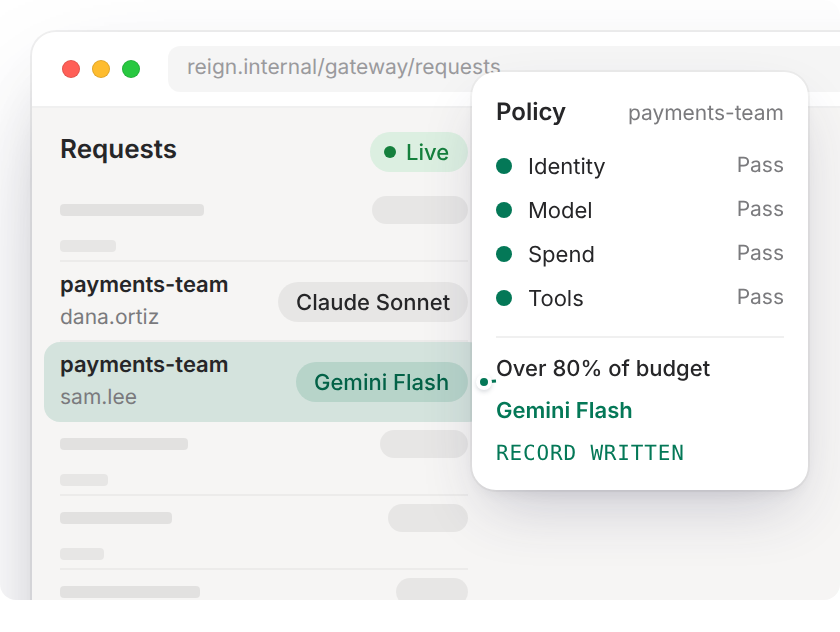
- Record. The ticket, the agent, the model, each check passed, and who approved it are kept in your storage.
AI software factory versus AI coding assistant
| Measure | AI coding assistant | AI software factory |
|---|---|---|
| Unit of work | A suggestion in an editor | A ticket in, a pull request out |
| Who drives | One developer | The line, with people approving |
| Checks | Whatever the developer runs | Every gate, on every change |
| Record | Usually none | Ticket, agent, model, checks and approver |
| What you measure | Activity | Changes delivered and kept |
What makes a software factory governed
Most teams can get a demo running. Month four is harder. A new model ships and the output changes overnight. A quality gate that passed in July fails in October. An auditor asks who approved a change, and what they saw. Six principles separate a demo from a governed line.
- Work arrives as tickets and leaves as pull requests. The line uses the tracker and review process your teams already trust.
- Every station runs the best tool for its job. The line makes sure every tool runs on every change.
- Your policy decides which changes need a named person. Agents never approve their own work. Neither does whoever runs the line for you.
- Every change leaves a record your risk team can read. It is kept in your storage, ready before anyone asks.
- The line runs in your account or an instance dedicated to you, on your keys. Swap a model without rebuilding how the work is governed.
- People run the line. Forward-deployed engineers work inside your delivery process from the first week.
This is governed AI software delivery: your approvals, your policy, your records. It describes how delivery is run. It is not an audit opinion or a certification.
How to measure an AI software factory
Count governed changes. A governed change is one change to your code that an agent produced, that passed your gates, that was approved and merged under your policy, by a named person on your team where the policy requires one, that left a record, and that was not reverted within 30 days.
Tokens spent, lines written and pull requests opened measure activity. A governed change measures delivery you can stand behind. Two questions follow: how many did your team ship this quarter, and what did each one cost?
Build or run
Every company will run a software factory. Few should build one. Building means owning the agents, the gates, the model changes, the records and the people who keep all of it working after the first quarter. Running one means someone operates the line for you, or with you, inside your own environment and under your policy.
Build if the line itself is your product or your edge. Run one if your edge is the software the line delivers.
What one line looks like, measured
One project from our own engineering team, August 12 to November 4, 2026:
- 967Pull requests merged.
- 14.9 hoursMedian time from opening a pull request to merge.
- 79%Reviewed by a second person.
Our own environment, a two-person team. Not a customer result. How we counted
Get the field guide, The Governed Line.
It has four working tools: a self-assessment, a governed change worksheet, a build-or-run decision table and a 90-day plan.